Can You Have a Baby Without Being Pregnant
T he Pacific Fertility Center on Los Angeles' Wilshire Boulevard is the identify where the people who have information technology all make their babies. With its crystal chandeliers and plush velvet and leather upholstery in shades of cream and mink, yous'd be forgiven for thinking the waiting room was the irresolute room of a high-finish bridal shop. Merely the pictures on the flatscreen on the wall give it away: digital photos of newborns in scratch mittens, cheers notes, family Christmas cards, tiny heads cradled in grateful hands. The images float up and disappear like bubbles in champagne.
In the 25 years Dr Vicken Sahakian has been practising, he has fabricated families for thousands of the most privileged people in the earth. He has worked with Hollywood stars, although he says he is also discreet to tell me names. ("You won't hear information technology from me, simply of course you would accept heard of them.") His clients are straight, gay, young and old, and they come to him from across the world, particularly from China, or parts of Europe where surrogacy is either illegal or very tightly regulated. In the UK, surrogacy is legal, just surrogates can claim only expenses for carrying a child for some other person. California police force allows surrogates to earn a profit, and upholds the rights of intended parents over anyone else who is involved in the creation of their babies. It's given the country a reputation equally the most surrogacy-friendly place in the world.
As diverse as they are, Sahakian'due south clients accept one thing in common: their power to beget his services. If you are open up to using other people's eggs, sperm or uteruses and are prepared to pay, anything is possible. "Money talks. If you take money, you're going to have a babe. It's sorry, only it is the case," Sahakian tells me less than v minutes after I sit down downward in his monochrome part. He wears greyness surgical scrubs embroidered with his proper name, his hair slicked back and greying at the temples. On his huge, black desk sits a glass paperweight containing a laser-engraved baby, next to a plastic uterus and fallopian tubes. But immediately after proverb this, he checks himself. "It isn't deplorable, actually – it'due south pretty happy. I believe in this type of science. I believe in family unit balancing, gender selection, selecting out abnormal embryos, using egg donors, sperm donors, this is what I exercise. I dearest what I do. The ultimate goal hither is bringing happiness for someone."
And every bit the range of fertility options open up to clients has diversified, then have their requests. At present, a growing number of women are coming to Sahakian for "social" surrogacy: they want to accept babies that are biologically their ain, just don't want to carry them. At that place is no medical reason for them to utilize a surrogate; they just choose not to be pregnant, and then they conceive babies through IVF and so hire another adult female to gestate and requite nativity to their baby. Information technology is the ultimate in outsourced labour.
Does he have whatever ethical concerns about social surrogacy? "I don't have issues with it," Sahakian says, smiling. "If you lot're a 28-year-old model or an actor and you lot get meaning, you're going to lose your task – you will. If you desire to use a surrogate, I'll help you."
Five years ago, Sahakian says he would preside over a handful of social surrogacy cases a twelvemonth; now he sees at least 20. "More than and more than every yr. And if I'one thousand seeing that, in that location are so many reproductive endocrinologists in the area who are very competent fertility specialists – I'grand sure they are seeing the aforementioned." It costs $150,000 to have a baby this style. "If social surrogacy was more affordable, more women would exist doing it, absolutely. There's an reward to being pregnant, the bonding, I empathize that, and from experience I tin say that nearly women dearest to be pregnant. But a lot of women don't want to be pregnant and lose a year of their careers."

The women looking for social surrogacy tend not to be the biggest celebrities, he says. Hollywood stars have the leverage to phone call the shots when it comes to schedules, and can take more confidence that their careers will exist waiting for them subsequently they have a baby. The typical candidates are models and actors who are doing well merely haven't still made their name. "They tell me signal blank, 'If I go significant, I will lose my part. I piece of work, I don't accept time because of piece of work. I model, I act, I look good like this and I don't want to disfigure my trunk.'"
I wince. Do yous disfigure your body when you get pregnant?
"You are definitely disfiguring your body, for that duration, and then if you don't practise the necessary exercises information technology's going to take you a while to get dorsum to normal. There's definitely some truth about pregnancy irresolute your body. Your pelvic bone opens up, you accumulate fat, you lot accumulate discoloration that doesn't become away. I'm non maxim that's a reason to use a surrogate, but it is for some people."
And what about the partners of the women who are getting other women to carry their babies, so their own bodies don't become disfigured? He always meets them, just he has never considered what they think about the procedure. "You know, I never ask that question. I never bring that up."
Sahakian describes himself as a feminist. "I am very proactive when it comes to women and I believe in that location is a double standard," he tells me. "Every day I see how prejudiced this society is, how male chauvinistic it is, how women are judged." This is more than than the unfairness of men being able to have careers and babies at the same time, when it is so much more than difficult for women. "If you are a 62-year-old human and you come up here with a 38-year‑erstwhile woman, no i asks why you lot're having a kid at 62. If yous come here as a 55-twelvemonth-old woman trying to have a kid, they tell yous yous're one-time, yous're a grandma, you're crazy. Larry Male monarch was, what, 75 when he had kids?" Male monarch was really 65, but Sahakian has a point. He himself is 56, with a wife who is 20 years younger, and 2 children under six.
The official guidelines set out by the American Social club for Reproductive Medicine (ASRM) say that gestational carriers – surrogates who deport babies conceived through IVF, with eggs from some other adult female – should be used but when there is a medical demand. But Sahakian has no qualms about "defining medical reasons broadly", equally he puts it. "What's the end result here? Somebody wants to exist a parent. I'm facilitating that. I empathise that it's controversial, it'south borderline unethical for some people, just put yourself in the shoes of a 26-year-quondam model who is making her living past modelling swimsuits. Tell me something – is it that unethical, to say permit'south not destroy this woman's career?"
Couldn't she wait until she'due south older to have a infant?
"Yep. Only what if you want to take a child now, and you don't want to be maybe xl when y'all have a kid? I don't think I'chiliad doing anything unethical past helping those couples. In this field, in Los Angeles, you can't judge clients. This is the wild west. 20 years agone helping a gay couple was taboo – it still is in Arkansas. We are so in the infancy of all of this."
Sahakian has a reputation for pushing boundaries, and he relishes it: information technology's given him a notoriety that drives his business. In 2001, he helped the oldest woman on tape in France, Jeanine Salomone, excogitate using donor eggs and requite birth at 62. A scandal erupted in French republic – where both surrogacy and bogus insemination of mail-menopausal women are illegal – when it emerged that Jeanine's brother, Robert, was the biological father of the son she gave birth to. Robert was severely disfigured later on a suicide attempt years earlier, and French journalists suggested the kid may have been conceived to secure an inheritance from Robert and Jeanine'south wealthy mother. The press descended on Sahakian, who said the siblings had presented themselves in his consulting room as a married couple, and that Jeanine had lied about her age. "I was put on the map," he tells me, only. "The bulletin from that was, this guy tin get a 62-year‑old woman pregnant. And so I had everybody over 50 calling me in the 2000s."
Then, in 2006, Sahakian became responsible for the oldest woman in the world on record to give nascence. Maria del Carmen Bousada, a retired sales assistant from Cadiz in Spain, had her twin boys the week earlier her 67th altogether. Bousada was diagnosed with cancer less than a yr after, and died in 2009, leaving her toddler sons orphaned.
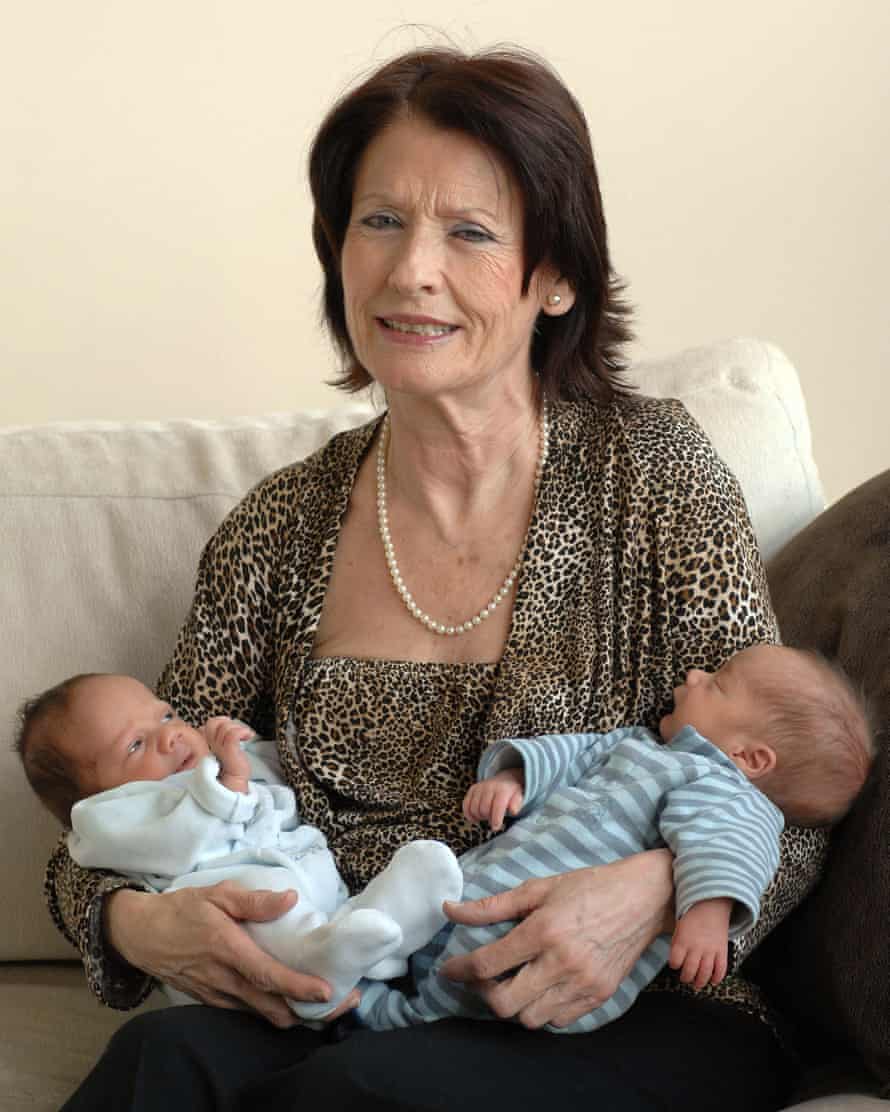
"That woman from Barcelona is in the Guinness Book of Records as the oldest adult female to give birth, actually," he says with a pride that feels grotesque. But when I ask him if he's happy with his reputation, he is defensive. "I didn't push the boundaries with the Castilian woman: she lied nearly her age, she said she was 57. She forged documents, she forged her medical records. With the French people, they had the same last name, we had their passports. Nosotros don't ask for union certificates, we don't ask for birth certificates. Which doctor asks for a nascency certificate?"
He feels no responsibility for her twins in Italian republic. "That's why I wouldn't treat a 67-yr-old adult female. She was a perfectly healthy 57-year‑old. She died from cancer, so she didn't have a pre-existing condition. You can get cancer at 28." He has since cut his upper age limit to 55, but still doesn't ask his clients for conclusive proof of age.
Sahakian says none of his social surrogacy patients volition talk to me, even anonymously. "They take nothing to gain." This isn't well-nigh vanity, he stresses, it's about the pressure women are under to maintain their careers at the same time as having children, and the women he sees have no interest in existence spokespeople for this new manner of having it all.
The taboo fastened to wanting to have some other woman carry your baby without any medical justification is so great that he says a couple of his clients really pretended to be pregnant, knowing that their pre-babe bodies would be there for them as before long equally the baby arrived. "You lot can buy bogus, prosthetic bellies, you lot know. You can buy them in dissimilar sizes. There'southward a reason why."
He is right. The current global leader in fake pregnant bellies is a family unit-run English business organisation called Moonbump. It produces remarkably realistic tummies in silicone and foam, in a range of five unlike skin tones and four different gestation sizes, with prices starting at £245 for a silicone model. Moonbump's products are used in dramas from EastEnders to Game Of Thrones to Bridget Jones's Baby, but it also caters to trans people and men with fetishes, and, as its website says, they are used "in many cases, for strengthening emotional bonds as you move forward with a planned surrogacy". There are several testimonials on its site from people using surrogates. Moonbump declined to exist interviewed for this article, emailing to say: "We provide a unimposing service for our customers and adopt not to answer any questions relating to the business organization."
L ook closely at the wording on whatever number of California-based fertility clinics' websites and you will see social surrogacy is on the cards. "Couples and individuals who are unable to take a babe on their ain, either biologically or through intention, can even so build and grow a family thank you to surrogacy," says the website of Growing Generations (my italics). "From medical to emotional to logistical and more than, the indications for gestational surrogacy tin vary significantly," says the Los Angeles Reproductive Center'southward surrogacy page. Neither dispensary agreed to exist interviewed for this piece. I contacted x divide California fertility clinics, and almost all readily admitted to conveying out social surrogacy, just none could provide former or current clients who were prepared to share their stories with me.
Women know it'due south not socially acceptable to acknowledge you want to exist a mother, but would rather another adult female carried and gave birth to your kid; but that doesn't stop some from thinking it, and even expressing it, under the veil of anonymity. Terminal year, an "Am I Being Unreasonable" thread on Mumsnet titled, "If yous had money to fire, would you use a surrogate?" asked users if they would "pay for an American surrogate if you simply didn't want to wait/go through the pregnancy?" The responses were mainly negative and outraged, but there were a striking number of women – at least vii – who said they would. "Oh God aye. I had horrible HG [hyperemesis] with both my pregnancies simply even putting that aside information technology's non an experience I savoured," said ane. "Yes I would. Pregnancy is horrible!" said some other. "In a heartbeat," said a third.

Social surrogacy is non just for Hollywood models and actors, Saira Jhutty a fertility psychologist, tells me. She works with women who are most to become surrogate mothers to cheque that they meet the ASRM guidelines: that they have already given nascency previously, sympathise the process and aren't going to accept attachment issues. Jhutty is based in San Diego, a hotbed for surrogacy with more than 20 fertility clinics and 16 agencies. She used to run her own agency, where she worked with several intended parents who were looking for surrogates for social reasons – and there may have been many more who disguised their reasons. "Information technology'southward notwithstanding taboo to say, 'I want to be a mother merely I don't want to carry.' They could have been telling us information technology was for medical reasons and we wouldn't know."
One particular client stands out in Jhutty'southward memory: a adult female who was candidature for political part. "It was election year and she knew she was going to have to exist on the political trail. If she wasn't out there doing what she needed to practise, her election run could be in jeopardy, but she wanted to accept a family," she tells me over the telephone. "She knew the potential side-effects, and how they could touch on her career, and she only felt, hey, I have this other option, I can notwithstanding be a mom and not jeopardise everything that I've been working for over the last how many years."
San Diego-based fertility specialist Dr Lori Arnold estimates that up to twenty% of the 100-200 clients she sees in her practice each year are at that place for social surrogacy. "Mainly it'south women with careers that don't let them the time, or the potential risk of being on bed residue," she tells me. "These are career women where information technology just doesn't fit into their schedule but they want to have a kid. It's becoming more of an option, and if it wasn't so expensive, I call up more women would do it." Many of her clients are wealthy Chinese women. "With patients that come up from China, information technology'south ordinarily about 80% that are social. They feel that after one pregnancy or ii the uterus is onetime, and that the success rate for an egg will be amend with a younger uterus. Information technology'south a cultural matter."
Nearly of Arnold'south surrogacy clients are women who are unable to carry babies themselves for medical reasons: they might have been built-in without a uterus, or had a hysterectomy, or take a pre-existing condition that would make pregnancy dangerous for them. "Most women desire to experience pregnancy and commitment and breastfeeding. Almost women really have that want. Simply some don't and nosotros have to respect that. I don't think information technology's anything bad: they do want to have a child and a family unit, but they don't desire to become pregnant and go through commitment. In my 25 years of experience I oasis't met anyone who really doesn't want to be pregnant – it's mainly a pick that their career has given to them."
As well as running her ain fertility clinic, Arnold has her own surrogacy agency to provide carriers for her patients. Given how crowded the field is in San Diego, she says finding surrogates tin be hard. "It's a very competitive market," she laments. When I enquire her how the surrogates feel most taking on the pregnancy of a adult female who has no medical reason not to comport the babe herself, I am shocked by her answer. "The surrogates really don't know the medical point of why the intended parents are seeking surrogacy," she tells me. "If they asked, if we had permission from the intended parent, nosotros would tell them. Just it'south a personal medical conclusion that I practise keep private and confidential."
There is no typical American surrogate. They vary widely in terms of their day task and level of education, just many have higher degrees and work total-fourth dimension. A pregnant proportion are armed forces wives: surrogacy agencies take been known to actively approach them; the hope of a paying job that allows them to stay at home with their ain children tin exist highly-seasoned for women who are lone parents while their husbands are away on deployment.
To authorize as a candidate, a woman must accept already given birth to their ain biological children, and ASRM guidelines limit the number of times a surrogate can carry to five pregnancies; only they aren't always enforced. Their average age is about 28. The widely held conventionalities that American surrogates are just doing it for the coin is likely be a misconception: this is not like shooting fish in a barrel money, and almost say they are motivated past the desire to bring joy to people who would otherwise accept no way of having their own family.
"One surrogate made an incredible comment to me," says Diane Batzofin, banana to San Diego-based Dr David Smotrich at La Jolla IVF, where she estimates v% of clients come for social surrogacy. "She said, 'So I must risk my life to save someone from having some stretchmarks?' and I said, 'No, it'south not exactly like that, and she said, 'That'south exactly how it feels to me.'"
Batzofin wants to brand articulate that the decision to use a social surrogate is not taken lightly. "There are women who have this thing about the hurting of childbirth," she says. "Then there are women who are on their ain and support themselves. What would happen if a woman like that ended upwards on bed residual? She'southward concerned most how she'd survive not fifty-fifty the pregnancy and bringing the child into the globe, but how she would survive financially [if complications meant she lost her chore]."
The clients she describes tend to be older than Sahakian's swimsuit models: they are in their late 30s, and often single. "What nosotros run across a lot at present is that women who are not married or fastened, who are in their early 30s, will salvage their eggs. It's a much larger market." If these women remain single and experience their jobs are under force per unit area, they might exist tempted to use the eggs they have frozen with donor sperm and a surrogate for social reasons. "Companies like Apple and Google are much more amenable to helping women, paying for them to freeze their eggs. They are much more progressive, in that sense," she tells me. That is one way of looking at it. It would be more progressive if these companies made it easier for women to accept breaks from their careers to have babies earlier in life. Is at that place a future where companies will support mothers looking for someone else to comport their baby, then that pregnancy doesn't interrupt their work? Information technology'southward a horrifying thought.
Batzofin is in her 60s; she has spent her entire working life in the fertility field, and several generations of babies have been conceived under her watch. "The field has changed dramatically, but the one thing that has not changed is the desire to procreate, in ane style or another, the desire to take some piece of yourself, in whatever manner it is," she says. Sometimes that want to accept some piece of yourself can stretch ethical limits in listen-extraordinary ways. Last yr, it emerged that her dominate had helped a wealthy British couple create a grandchild using sperm extracted from their 26-year-old son three days after he was killed in a motorcycle blow. The man had been single at the time; he never gave consent for the procedure when he was alive, making it illegal under English law. Smotrich used a donor and a surrogate, and gender selection to ensure the baby born was a boy. "The English couple lost their son under the most tragic of circumstances. They desperately wanted an heir and a grandchild. It was a privilege to be able to help them," he told the Mail On Sunday.
There is no doubt that the doctors who offer social surrogacy are at the virtually extreme end of fertility treatment. Merely these same doctors have led the way when it comes to creating families for same sex couples, and unmarried men and women; Smotrich was one of the first doctors in the US to help a gay couple get parents, and was behind the procedure that immune the first unmarried man in the UK to take his own children without a female person partner. Could this exist another boundary American fertility doctors are pushing through, which the rest of the earth volition i 24-hour interval follow?
B ack at the Pacific Fertility Eye, underneath Sahakian'due south framed medical certificates, I put this to him: that in twenty years people will think of social surrogacy as no more unnatural than surrogacy for gay couples.
"Xx? No, a couple of years from now. We're already almost there. Surrogacy isn't taboo whatever more. In the Britain, y'all are so far backside us. Thank God – so many of my clients come up from the United kingdom of great britain and northern ireland, it's good for concern! But that's going to alter."
The rising of social surrogacy is 1 of many possible futures, then long as nosotros live in a world where it can be difficult for some women to be pregnant. These women are shouldering the burden of a society where, in some highly visible or demanding jobs, you tin't become a mother without risking your livelihood. Instead of making their working lives easier, we are creating an industry where they tin can hire other women to carry babies for them.
But the existence of social surrogacy, and the secrecy that currently surrounds it, perpetuates the idea that it is possible for those women to have information technology all, to have coveted jobs in business, politics, acting and modelling, and to have children and perfect bodies at the same time – and be utterly unchanged by the procedure of having babies.
I inquire Sahakian if he isn't creating an impossible illusion? Only he shrugs it off. "These aren't large numbers in the scheme of things. I don't think information technology'due south a social problem. I tin see both sides, but I'm not going to approximate." He sits dorsum in his chair, and smiles. "I am comfortable with what I practice. I like what I practice. My goal is to make my patients happy."
Jenny Kleeman is writing a book about the future of nascence, food, sex and death, to be published by Picador in 2020.
If you would like a comment on this piece to exist considered for inclusion on Weekend magazine'southward letters page in print, please email weekend@theguardian.com, including your name and address (non for publication).
Comments on this piece are premoderated to ensure the discussion remains on the topics raised past the article. Please exist aware that there may be a brusque delay in comments appearing on the site.
montanezveragiclumad.blogspot.com
Source: https://www.theguardian.com/lifeandstyle/2019/may/25/having-a-child-doesnt-fit-womens-schedule-the-future-of-surrogacy#:~:text=There%20is%20no%20medical%20reason,the%20ultimate%20in%20outsourced%20labour.
0 Response to "Can You Have a Baby Without Being Pregnant"
Postar um comentário